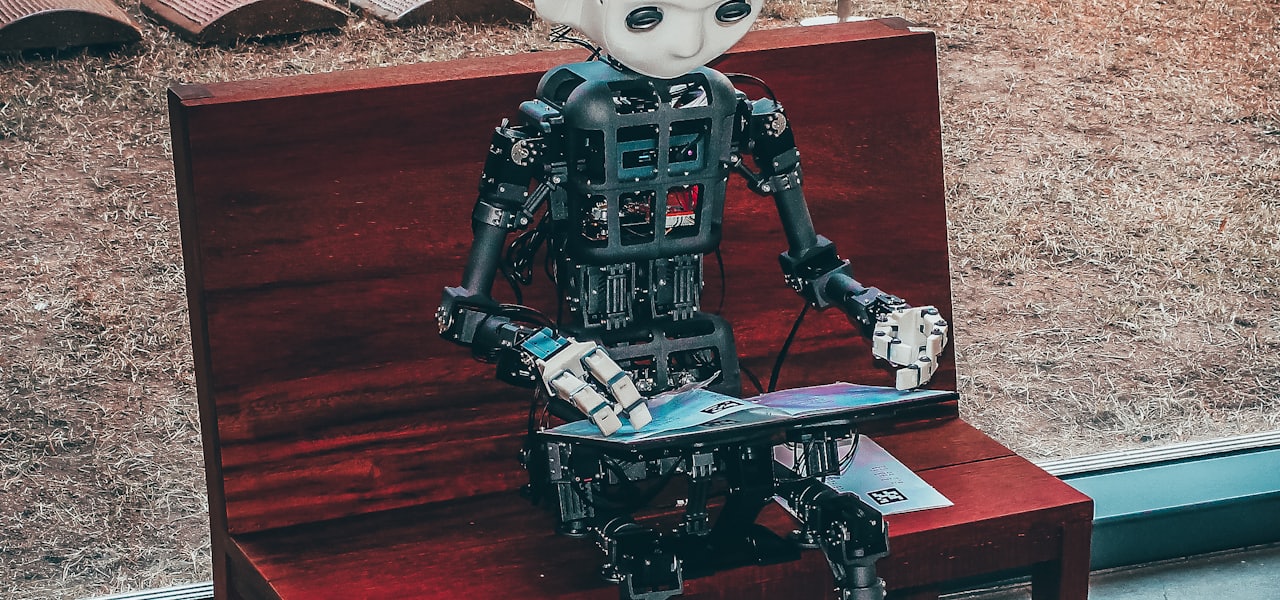
Artificial intelligence in customer experience is the use and development of artificial intelligence (AI) to aid and improve customer experience (sometimes abbreviated to CX AI). Chatbots are often seen as the first step in the development of AI within the industry, but more tailored offerings are slowly becoming available. The use of artificial intelligence in the space has since become more diverse than simply chatbots, with AI underpinning entire CX cloud platforms now used at major corporations. Contact center as a service (CCaaS) has become a core solution of the CX (customer experience) industry, with the CCaaS market size expected to reach $17.19 Billion by 2030 in the United States alone. == History == As with many AI applications, CX AI early implementation case studies have demonstrated that AI can increase the quality of customer interactions and therefore the overall experience that organizations can provide. This in turn has suggested a higher return on investment and/or revenue as a result. The beginning of the revolution of customer experience and the use of machine learning was with chatbots. The use of this type of AI can be traced back to Alan Turing in 1950, when the Church–Turing thesis suggested that computers could use "formal reasoning" to reach conclusions. In 2017, Meta produced one of the first breakthroughs for everyday use of AI for customer experience when it allowed Facebook users to create their own messaging bots for free on its Facebook messenger platform. The main focus of this was to both automate and improve customer experience and interaction. In 2023, CCaaS vendors began announcing the integration of ChatGPT’s generative AI into their CX solutions. Generative AI adds a layer of semantics into AI outputs. This was a major breakthrough for conversational AI. Using natural language processing and conversational AI, chatbots could enhance the level of service they could provide, speaking to customers in an easy-to-understand and conversational tone. == Applications == Currently the main location for the application of CX AI in the sector is in contact centers. Historically, contact centers were simply known as call centers, but in recent years differentiation developed between the two terms. Call centers provide phone support, while contact centers also provide support via digital channels in addition to analogue phone systems. Contact centers are therefore seen as a complete customer service solution, where as call centers simply cover one aspect of customer interactions. As a part of improving CX, AI is also improving the employee experience. AI is able to automate tasks to free up time for contact center agents to focus on higher priority tasks. For example, AI can be used for auto summarization. This means that instead of human agents having to summarize customer interactions now AI can do it, saving organizations time and money.
Application performance engineering
Application performance engineering is a method to develop and test application performance in various settings, including mobile computing, the cloud, and conventional information technology (IT). == Methodology == According to the American National Institute of Standards and Technology, nearly four out of every five dollars spent on the total cost of ownership of an application is directly attributable to finding and fixing issues post-deployment. A full one-third of this cost could be avoided with better software testing. Application performance engineering attempts to test software before it is published. While practices vary among organizations, the method attempts to emulate the real-world conditions that software in development will confront, including network deployment and access by mobile devices. Techniques include network virtualization.
Globetrooper
Globetrooper is a free travel app known for assisting travelers in finding partners for group trips and world adventures. Globetrooper offers a free social travel platform that helps people find travel partners. == History == Globetrooper was developed and released in 2010 by a couple; Todd Sullivan and Lauren McLeod who are two travel-minded individuals that wanted to make it easier for travelers to plan a journey and see the world. With their backgrounds in business, software & design, and a love for travel, both left the corporate world and launched Globetrooper on Lauren’s birthday 28 March 2010. Globetrooper was first launched as an information portal with a view to making it more social, but after some months, the content quickly grew and changed to the ‘travel partner’ concept.
Referring expression generation
Referring expression generation (REG) is the subtask of natural language generation (NLG) that received most scholarly attention. While NLG is concerned with the conversion of non-linguistic information into natural language, REG focuses only on the creation of referring expressions (noun phrases) that identify specific entities called targets. This task can be split into two sections. The content selection part determines which set of properties distinguish the intended target and the linguistic realization part defines how these properties are translated into natural language. A variety of algorithms have been developed in the NLG community to generate different types of referring expressions. == Types of referring expressions == A referring expression (RE), in linguistics, is any noun phrase, or surrogate for a noun phrase, whose function in discourse is to identify some individual object (thing, being, event...) The technical terminology for identify differs a great deal from one school of linguistics to another. The most widespread term is probably refer, and a thing identified is a referent, as for example in the work of John Lyons. In linguistics, the study of reference relations belongs to pragmatics, the study of language use, though it is also a matter of great interest to philosophers, especially those wishing to understand the nature of knowledge, perception and cognition more generally. Various devices can be used for reference: determiners, pronouns, proper names... Reference relations can be of different kinds; referents can be in a "real" or imaginary world, in discourse itself, and they may be singular, plural, or collective. === Pronouns === The simplest type of referring expressions are pronoun such as he and it. The linguistics and natural language processing communities have developed various models for predicting anaphor referents, such as centering theory, and ideally referring-expression generation would be based on such models. However most NLG systems use much simpler algorithms, for example using a pronoun if the referent was mentioned in the previous sentence (or sentential clause), and no other entity of the same gender was mentioned in this sentence. === Definite noun phrases === There has been a considerable amount of research on generating definite noun phrases, such as the big red book. Much of this builds on the model proposed by Dale and Reiter. This has been extended in various ways, for example Krahmer et al. present a graph-theoretic model of definite NP generation with many nice properties. In recent years a shared-task event has compared different algorithms for definite NP generation, using the TUNA corpus. === Spatial and temporal reference === Recently there has been more research on generating referring expressions for time and space. Such references tend to be imprecise (what is the exact meaning of tonight?), and also to be interpreted in different ways by different people. Hence it may be necessary to explicitly reason about false positive vs false negative tradeoffs, and even calculate the utility of different possible referring expressions in a particular task context. === Criteria for good expressions === Ideally, a good referring expression should satisfy a number of criteria: Referential success: It should unambiguously identify the referent to the reader. Ease of comprehension: The reader should be able to quickly read and understand it. Computational complexity: The generation algorithm should be fast No false inferences: The expression should not confuse or mislead the reader by suggesting false implicatures or other pragmatic inferences. For example, a reader may be confused if he is told Sit by the brown wooden table in a context where there is only one table. == History == === Pre-2000 era === REG goes back to the early days of NLG. One of the first approaches was done by Winograd in 1972 who developed an "incremental" REG algorithm for his SHRDLU program. Afterwards researchers started to model the human abilities to create referring expressions in the 1980s. This new approach to the topic was influenced by the researchers Appelt and Kronfeld who created the programs KAMP and BERTRAND and considered referring expressions as parts of bigger speech acts. Some of their most interesting findings were the fact that referring expressions can be used to add information beyond the identification of the referent as well as the influence of communicative context and the Gricean maxims on referring expressions. Furthermore, its skepticism concerning the naturalness of minimal descriptions made Appelt and Kronfeld's research a foundation of later work on REG. The search for simple, well-defined problems changed the direction of research in the early 1990s. This new approach was led by Dale and Reiter who stressed the identification of the referent as the central goal. Like Appelt they discuss the connection between the Gricean maxims and referring expressions in their culminant paper in which they also propose a formal problem definition. Furthermore, Reiter and Dale discuss the Full Brevity and Greedy Heuristics algorithms as well as their Incremental Algorithm(IA) which became one of the most important algorithms in REG. === Later developments === After 2000 the research began to lift some of the simplifying assumptions, that had been made in early REG research in order to create more simple algorithms. Different research groups concentrated on different limitations creating several expanded algorithms. Often these extend the IA in a single perspective for example in relation to: Reference to Sets like "the t-shirt wearers" or "the green apples and the banana on the left" Relational Descriptions like "the cup on the table" or "the woman who has three children" Context Dependency, Vagueness and Gradeability include statements like "the older man" or "the car on the left" which are often unclear without a context Salience and Generation of Pronouns are highly discourse dependent making for example "she" a reference to "the (most salient) female person" Many simplifying assumptions are still in place or have just begun to be worked on. Also a combination of the different extensions has yet to be done and is called a "non-trivial enterprise" by Krahmer and van Deemter. Another important change after 2000 was the increasing use of empirical studies in order to evaluate algorithms. This development took place due to the emergence of transparent corpora. Although there are still discussions about what the best evaluation metrics are, the use of experimental evaluation has already led to a better comparability of algorithms, a discussion about the goals of REG and more task-oriented research. Furthermore, research has extended its range to related topics such as the choice of Knowledge Representation(KR) Frameworks. In this area the main question, which KR framework is most suitable for the use in REG remains open. The answer to this question depends on how well descriptions can be expressed or found. A lot of the potential of KR frameworks has been left unused so far. Some of the different approaches are the usage of: Graph search which treats relations between targets in the same way as properties. Constraint Satisfaction which allows for a separation between problem specification and the implementation. Modern Knowledge Representation which offers logical inference in for example Description Logic or Conceptual Graphs. == Problem definition == Dale and Reiter (1995) think about referring expressions as distinguishing descriptions. They define: The referent as the entity that should be described The context set as set of salient entities The contrast set or potential distractors as all elements of the context set except the referent A property as a reference to a single attribute–value pair Each entity in the domain can be characterised as a set of attribute–value pairs for example ⟨ {\displaystyle \langle } type, dog ⟩ {\displaystyle \rangle } , ⟨ {\displaystyle \langle } gender, female ⟩ {\displaystyle \rangle } or ⟨ {\displaystyle \langle } age, 10 years ⟩ {\displaystyle \rangle } . The problem then is defined as follows: Let r {\displaystyle r} be the intended referent, and C {\displaystyle C} be the contrast set. Then, a set L {\displaystyle L} of attribute–value pairs will represent a distinguishing description if the following two conditions hold: Every attribute–value pair in L {\displaystyle L} applies to r {\displaystyle r} : that is, every element of L {\displaystyle L} specifies an attribute–value that r {\displaystyle r} possesses. For every member c {\displaystyle c} of C {\displaystyle C} , there is at least one element l {\displaystyle l} of L {\displaystyle L} that does not apply to c {\displaystyle c} : that is, there is an l {\displaystyle l} in L {\displaystyle L} that specifies an attribute–value that c {\displaystyle c} does not possess. l {\displaystyle l} is said
Artificial Linguistic Internet Computer Entity
A.L.I.C.E. (Artificial Linguistic Internet Computer Entity), also referred to as Alicebot, or simply Alice, is a natural language processing chatbot—a program that engages in a conversation with a human by applying some heuristical pattern matching rules to the human's input. It was inspired by Joseph Weizenbaum's classical ELIZA program. It is one of the strongest programs of its type and has won the Loebner Prize, awarded to accomplished humanoid, talking robots, three times (in 2000, 2001, and 2004). The program is unable to pass the Turing test, as even the casual user will often expose its mechanistic aspects in short conversations. Alice was originally composed by Richard Wallace; it "came to life" on November 23, 1995. The program was rewritten in Java beginning in 1998. The current incarnation of the Java implementation is Program D. The program uses an XML Schema called AIML (Artificial Intelligence Markup Language) for specifying the heuristic conversation rules. Alice code has been reported to be available as open source. The AIML source is available from ALICE A.I. Foundation on Google Code and from the GitHub account of Richard Wallace. These AIML files can be run using an AIML interpreter like Program O or Program AB. == In popular culture == Spike Jonze has cited ALICE as the inspiration for his academy award-winning film Her, in which a human falls in love with a chatbot. In a New Yorker article titled “Can Humans Fall in Love with Bots?” Jonze said “that the idea originated from a program he tried about a decade ago called the ALICE bot, which engages in friendly conversation.” The Los Angeles Times reported:Though the film’s premise evokes comparisons to Siri, Jonze said he actually had the idea well before the Apple digital assistant came along, after using a program called Alicebot about ten years ago. As geek nostalgists will recall, that intriguing if at times crude software (it flunked the industry-standard Turing Test) would attempt to engage users in everyday chatter based on a database of prior conversations. Jonze liked it, and decided to apply a film genre to it. “I thought about that idea, and what if you had a real relationship with it?” Jonze told reporters. “And I used that as a way to write a relationship movie and a love story.”
Hildon
Hildon is an application framework originally developed for mobile devices (PDAs, mobile phones, etc.) running the Linux operating system as well as the Symbian operating system. The Symbian variant of Hildon was discontinued with the cancellation of Series 90. It was developed by Nokia for the Maemo operating system. It focuses on providing a finger-friendly interface. It is primarily a set of GTK extensions that provide mobile-device–oriented functionality, but also provides a desktop environment that includes a task navigator for opening and switching between programs, a control panel for user settings, and status bar, task bar and home applets. It is standard on the Maemo platform used by the Nokia Internet Tablets and the Nokia N900 smartphone. Hildon has also been selected as the framework for Ubuntu Mobile and Embedded Edition. Hildon was an early instance of a software platform for generic computing in a tablet device intended for internet consumption. But Nokia didn't commit to it as their only platform for their future mobile devices and the project competed against other in-house platforms. The strategic advantage of a modern platform was not exploited, being displaced by the Series 60, though its development is continued by the Maemo Leste project. == Components == The Hildon framework includes components that effectively provide a desktop environment. === Hildon Application Manager === Hildon Application Manager is the Hildon graphical package manager, it uses the Debian package management tools APT (Advanced Packaging Tool and dpkg) and provides a graphical interface for installing, updating and removing packages. It is a limited package manager, designed specifically for end-users, in that it doesn't directly offer the user access to system files and libraries. With the Diablo release of Maemo, Hildon Application Manager now supports "Seamless Software Update" (SSU), which implements a variety of features to allow system upgrades to be easily performed through it. === Hildon Control Panel === Hildon Control Panel is the user settings interface for Hildon. It provides simple access to control panels used to change system settings. === Hildon Desktop === Hildon Desktop is the primary UI component of Hildon, so makes up the bulk of what a user will see as "Hildon". It controls application launching and switching, general system control, and provides interfaces for task bar (application menu and task switcher), status bar (brightness and volume control), and home (internet radio and web search) applets. === Hildon Library === The Hildon library, originally developed by Nokia but since Maemo 5, developed by Igalia and Lanedo (who developed MaemoGTK+, the Maemo version of GTK+). It is a set of mobile specific GTK+ widgets for applications in Maemo. Up to Maemo 4, these widgets were designed for stylus usage. However, in Maemo 5, most widgets were deprecated and new widgets for direct finger manipulation were introduced, including a kinetic panning container.
List of large language models
A large language model (LLM) is a type of machine learning model designed for natural language processing tasks such as language generation. LLMs are language models with many parameters, and are trained with self-supervised learning on a vast amount of text. == List == For the training cost column, 1 petaFLOP-day equals 1 petaFLOP/sec × 1 day, or 8.64×10¹⁹ FLOP (floating point operations). Only the cost of the largest model is shown. The number of parameters is measured in billions, and the training cost is measured in petaFLOP-days. === 2018 === === 2019 === === 2020 === === 2021 === === 2022 === === 2023 === === 2024 === === 2025 === === 2026 ===